Lawn guide · Sydney
Best Turf for Dogs and Families in Sydney
A practical guide to choosing turf that can handle paws, play, winter and everyday family life.
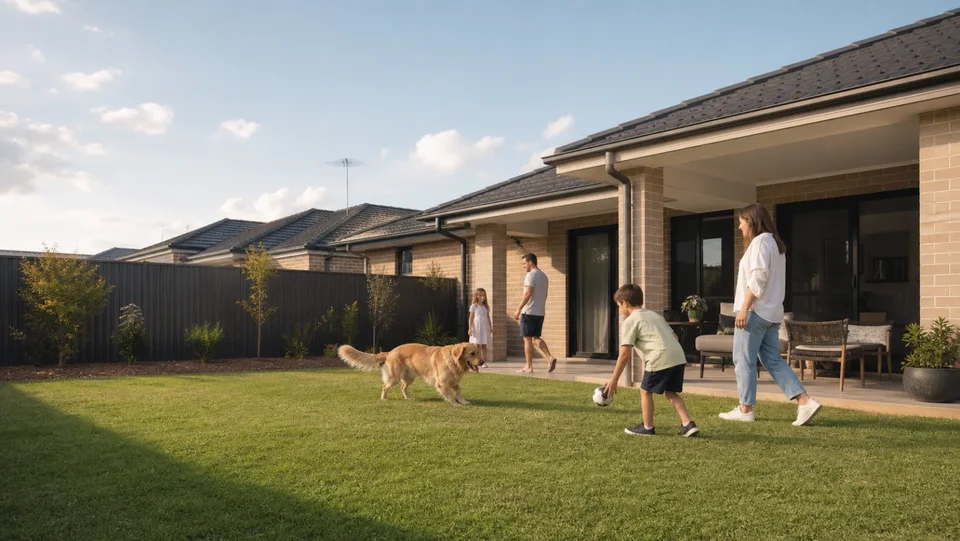
A dog-friendly lawn needs to do more than look good in a photo.
It has to handle running, sharp turns, toilet spots, muddy paws and the same track being used between the back door and the fence every day.
For a sunny Sydney backyard, we love Kikuyu. It grows strongly, handles wear and can repair damaged areas faster than most turf varieties during the warmer months.
The trick is not only choosing tough turf. It is helping the lawn stay thick enough that dogs do not tear it apart, especially during winter when Kikuyu naturally slows down.
That is why we may seed annual ryegrass through new Kikuyu for its first winter and provide a Seasol-based mix to help strengthen the lawn and support recovery from everyday stress, including dog urine.
The quick answer
For a sunny yard with active dogs, Kikuyu is usually our first choice.
It grows quickly, repairs wear and stands up well to real family use. During its first winter, temporary annual ryegrass can help keep the lawn greener and more covered while the Kikuyu slows down. That extra cover can mean less exposed soil, less mud and less chance of dogs ripping up a thin lawn.
A Seasol-based treatment can also support the grass while it establishes and help it recover from stress caused by regular use and dog urine.
Sir Walter Buffalo may be the better choice where the yard has a mixture of sun and shade, but for toughness and fast repair in full sun, we find Kikuyu hard to beat.
Why dogs are hard on lawns
Most dogs do not use a backyard evenly.
They follow the same route to the gate.
They race along the fence.
They turn sharply near the back door.
They toilet in a favourite spot.
Over time, all that pressure becomes concentrated into a few small areas.
A lawn may be 100 square metres, but the dog could be putting most of its wear onto a strip only one metre wide.
Dogs can damage grass through:
- Repeated running and turning
- Skidding on wet ground
- Compacted soil beneath regular pathways
- Urinating in the same area
- Digging
- Wearing down grass near doors and gates
- Playing on new turf before it has taken root
No natural turf is completely dog-proof.
The goal is to choose a variety that grows back well, prepare the soil properly and help the lawn remain thick enough to cope.
Why we love Kikuyu for dogs
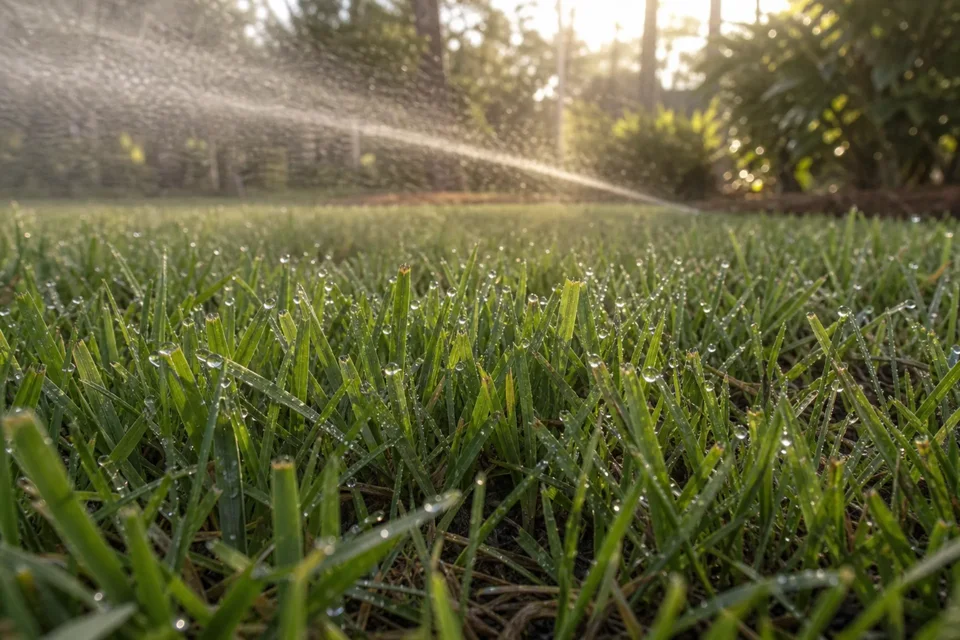
Kikuyu is tough.
Give it good sunlight, suitable soil and enough warmth and it will grow strongly through spring and summer. Its runners help it spread back into worn and damaged areas rather than leaving every bare patch permanently open.
That is a major advantage in a yard with dogs.
A lawn that repairs itself quickly is much more useful than one that looks perfect until the first rough weekend.
Kikuyu is usually a strong choice when:
- The yard receives plenty of direct sun.
- One or more dogs use the lawn every day.
- Children also play outside regularly.
- The lawn needs to recover from wear.
- You are happy to mow more often during warmer weather.
- You can keep active runners out of garden beds.
Kikuyu is not especially interested in staying inside the border you gave it. It grows quickly and needs regular mowing and edging when conditions are good.
But that same active growth is exactly why we like it for dogs.
You cannot ask for a lawn that repairs quickly and then be surprised when it grows quickly too.
The winter problem for dog lawns
Kikuyu loves warm weather.
When Sydney temperatures fall, its growth slows. Colour may fade and damaged areas take longer to repair.
That is not usually a problem in a quiet backyard.
It can become a problem when dogs continue running across the same areas every day.
The grass slows down, but the dog does not.
A thin winter lawn can quickly become:
- Worn through near the back door
- Muddy after rain
- Bare along the fence
- Torn up during sharp turns
- Compacted in favourite toilet areas
Once the turf becomes thin, dogs can catch the remaining runners with their paws and pull them up more easily.
That is why keeping useful cover through the first winter can make such a difference.
Annual ryegrass can help through the first winter
Where appropriate, we can seed annual ryegrass through new Kikuyu.
Annual ryegrass grows during the cooler months, when Kikuyu is slowing down. It helps keep the lawn greener and provides extra cover through winter.
That extra cover is particularly useful in a home with dogs.
A thicker winter lawn means:
- Less exposed soil
- Less mud after rain
- More protection around Kikuyu runners
- Less chance of paws ripping into thin areas
- A more usable backyard during cooler months
The annual ryegrass is temporary.
As temperatures rise and summer returns, the ryegrass naturally fades and dies off. The Kikuyu becomes active again and takes over the lawn.
It is not replacing the Kikuyu or changing the long-term lawn variety.
Think of it as helping the Kikuyu through its first winter while it is still becoming established.
Our Seasol mix helps support the lawn
We also provide a Seasol-based mix to help strengthen the turf and support it while it settles into its new home.
This is useful in any new lawn, but it can be especially helpful where dogs are going to create additional stress.
The mix can support:
- Root development
- Early establishment
- Recovery from regular traffic
- General plant strength
- Recovery from mild urine stress
It does not make grass immune to dog urine, and it will not save one small patch being heavily urinated on several times every day.
What it does is support a healthier, stronger lawn that has a better chance of coping and recovering.
For a dog owner, that matters.
A lawn with healthy growth is better able to fill small damaged areas before they become bare, muddy patches.
Does dog urine kill grass?
Yes, concentrated dog urine can burn and kill grass.
It often creates a yellow or brown centre, sometimes surrounded by a darker green ring. The outer ring receives enough nitrogen to encourage growth, while the centre receives too much at once.
The amount of damage depends on:
- How concentrated the urine is
- How often the same spot is used
- The size of the lawn
- Soil moisture
- Drainage
- Weather
- The health of the grass
One dog using different parts of a large lawn may leave very little visible damage.
Two dogs using the same small patch beside the back door can kill it repeatedly.
How to reduce urine damage
Encourage the dog to use different parts of the yard where possible.
For smaller lawns, consider creating a dedicated toilet area using gravel, mulch or another suitable surface.
If you see the dog urinate, lightly watering that spot afterwards can help dilute the concentration. You do not need to flood the whole lawn every time.
Maintaining a thick, actively growing lawn also helps. This is where the combination of strong Kikuyu, winter ryegrass cover and a supportive Seasol treatment can be useful.
Avoid random household remedies or products claiming to completely neutralise urine.
Some can cause new soil problems, and changes to your dog’s food or supplements should always be discussed with a vet.
Where will your dog damage the lawn first?
Before ordering turf, look at how your dog already uses the yard.
Watch for a few days and mark:
- The path from the back door
- The dog door
- The side gate
- The fence line
- Favourite toilet spots
- Sharp turning points
- The bottom of stairs
- Shaded areas where the ground stays damp
- Places where water collects after rain
These areas usually fail first because every trip crosses the same small space.
Even tough Kikuyu may thin where a large dog repeatedly accelerates, stops or turns.
In these concentrated areas, a small path or hard-wearing landing may work better than turf alone.
That does not mean giving up on a natural lawn.
It means keeping turf in the parts of the yard where it has enough room, light and soil to perform properly.
A dog door can be harder on turf than a large dog
Dog size is not the only thing that matters.
A large dog wandering around a spacious sunny lawn may cause less damage than a small dog using the same two-metre strip twenty times a day.
Dog doors are a common example.
Every trip begins and ends in exactly the same place. If that spot is shaded, wet or compacted, the lawn has almost no time to recover.
Consider placing:
- A short paved landing
- Stepping stones
- Gravel
- Another suitable hard-wearing surface
immediately outside the dog door.
The dog can then reach the lawn without tearing apart the same small patch every time it goes outside.
Prepare the soil for paws
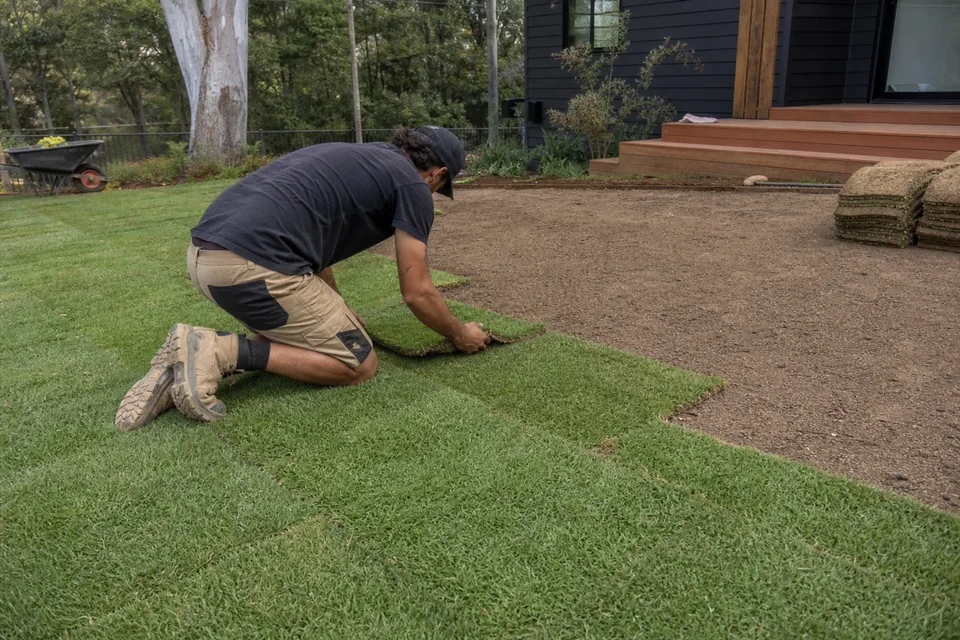
Tough turf still needs suitable soil underneath it.
Dogs compact ground over time, particularly when the soil is wet. Compacted soil restricts water, air and root growth, making it harder for damaged grass to repair.
Before laying new turf:
- Remove old grass and weeds.
- Clear builders’ rubble and unsuitable fill.
- Break up compacted soil.
- Correct low areas where water pools.
- Add suitable turf underlay where needed.
- Create a smooth, firm base that roots can enter.
- Make sure water drains away from buildings.
A muddy dog lawn is not always a turf problem.
It may be a drainage or soil problem.
If the ground stays soft after rain, dogs will churn it up regardless of the variety on top.
Get the base right and Kikuyu has a much better chance of doing what it does best: growing and repairing.
Keep dogs off new turf while it establishes
Do not lay new turf and let the dog run across it that afternoon.
Fresh turf has not yet attached to the soil underneath. Dogs can move the rolls, tear young roots and create low spots before the lawn has had a chance to settle.
Use the gentle pull test.
Carefully lift a corner in several areas:
- If it lifts easily, it is not ready for normal traffic.
- If there is resistance, roots are beginning to hold.
Keep pets off the new lawn as much as possible during this stage.
Before delivery, organise:
- A temporary toilet area
- Another part of the yard
- Short lead access
- Temporary fencing, if needed
The exact establishment time depends on the season, weather, soil and turf variety.
Winter-laid turf usually takes longer to attach because growth is slower.
It is worth being patient. A few careful weeks at the beginning can prevent months of repairing a lawn that was damaged before it had properly started.
What about Sir Walter Buffalo?
Sir Walter Buffalo can still be a very good family lawn.
It is often worth considering when the yard receives a mixture of sun and shade. It has a broad, soft-looking leaf and is generally less aggressive around garden beds than Kikuyu.
However, buffalo normally does not repair heavy wear as quickly as actively growing Kikuyu.
That matters if dogs repeatedly:
- Race along the fence
- Skid around corners
- Use the same toilet spot
- Run through one narrow gate
- Play heavily on a small lawn
We would usually consider Sir Walter where:
- The yard has mixed sunlight.
- Dog traffic is moderate.
- Use is spread across the lawn.
- The owner prefers a broad-leaf appearance.
- Less aggressive growth is important.
“Shade tolerant” does not mean “grows in darkness”.
A shaded, heavily used strip can still fail, even with buffalo.
The dog, sunlight and layout all need to be considered together.
Three common dog-yard situations
Two active dogs in a sunny Western Sydney backyard
Kikuyu is usually the first option we would consider.
Strong sun helps it grow and repair quickly through the warmer months. A larger yard also allows the dogs to spread their activity rather than wearing one narrow strip.
For the first winter, annual ryegrass can help maintain colour and cover while the Kikuyu slows down.
The Seasol mix supports the turf as it establishes and deals with the extra stress of a busy dog yard.
One dog in a small courtyard
The lawn may receive enough sun, but every trip crosses the same few metres.
Kikuyu may still be the best turf choice, but the area immediately outside the door may need paving, gravel or another hard-wearing surface.
Otherwise, concentrated traffic and urine can overwhelm the grass regardless of how tough it is.
A dog and children in a partly shaded backyard
The yard receives morning sun and afternoon shade from the house.
Sir Walter may suit the mixed light better, provided the traffic is moderate and the lawn still receives useful sunlight.
Move trampolines, paddling pools and play equipment occasionally so one section is not shaded and worn for months.
Keeping a dog lawn healthy
Mow regularly
Regular mowing encourages a denser lawn.
Do not let Kikuyu become very long and then remove most of the leaf in one cut.
During warm weather, it may need mowing more often than expected. That active growth is helping the lawn repair itself.
Keep the mower blades sharp
Blunt blades tear the grass and leave the lawn looking pale and rough.
A clean cut helps the turf recover more quickly.
Water properly
New turf needs consistent moisture while it takes root.
Once established, water more deeply and less often according to the weather, soil and current watering rules.
Constant shallow watering can create weak surface roots and leave the lawn soft underfoot.
Repair small patches early
A small urine burn or thin strip is easier to manage before it becomes a muddy hole.
Work out what caused the damage:
- Urine
- Shade
- Traffic
- Compaction
- Poor sprinkler coverage
- Drainage
Then address the cause rather than simply throwing fertiliser at it.
Ease the pressure during wet weather
Dogs can tear up soft ground very quickly.
After heavy rain, give worn areas time to firm up where possible. Use another route or part of the yard rather than repeatedly sending the dog across the wettest section.
Keep the lawn covered through winter
For new Kikuyu lawns, annual ryegrass can make winter much easier.
The extra green cover helps protect the surface while the Kikuyu is resting, reducing exposed mud and giving the yard a better chance of handling regular dog use.
Why how the turf is grown matters
Dogs lie on the grass.
Children play barefoot on it.
Families spend years using it.
We think it is worth knowing where that turf came from and how it was grown.
Demarco Sydney Turf grows using regenerative principles focused on healthy soil, strong grass and less reliance on chemicals wherever practical.
That does not make the lawn impossible to damage.
But it gives the turf a strong start before it reaches your home.
When that is combined with the right variety, annual ryegrass for the first winter where appropriate, a supportive Seasol mix and good preparation at home, you have the foundation for a lawn that can genuinely handle family life.
Frequently asked questions
What is the best turf for dogs in Sydney?
For a sunny yard with active dogs, Kikuyu is usually our first choice. It grows strongly, repairs worn areas and handles regular use well during its active growing season. Where the yard has more shade, Sir Walter Buffalo may be a better fit.
Why add annual ryegrass to Kikuyu?
Kikuyu slows down during winter. Annual ryegrass grows in cooler conditions and provides temporary green cover while the Kikuyu is resting. This can help reduce bare soil, mud and the chance of dogs ripping up a thin new lawn. The ryegrass naturally fades as summer returns and the Kikuyu becomes active again.
Does Seasol stop dog urine from burning grass?
It does not neutralise dog urine or make the turf immune to damage. The Seasol-based mix helps strengthen the lawn and support recovery from general stress, including mild urine damage. Repeated urination in one small spot may still kill the grass.
Can dog urine kill Kikuyu?
Yes. Kikuyu is tough, but concentrated urine can still burn it, especially when the same spot is used repeatedly. Encourage the dog to use different areas, lightly water fresh urine spots and consider a dedicated toilet area.
Is there a completely dog-proof lawn?
No natural grass is completely dog-proof. Sunlight, soil, drainage, traffic and the dog’s habits all affect how well a lawn performs. Kikuyu is one of the toughest practical choices for a sunny dog yard, but even Kikuyu needs a fair chance to grow.
How long should dogs stay off new turf?
Keep dogs off until the turf has rooted firmly and no longer lifts easily. The timing depends on the season and growing conditions. Turf laid during winter or in shade may need longer.
Is Kikuyu too rough for a family lawn?
Modern, well-maintained Kikuyu can make an excellent family lawn. Regular mowing keeps it dense and comfortable underfoot. Its toughness and fast repair are major advantages in a yard used by children and dogs.
What if my dog always runs along the same fence?
That narrow track may wear even tough turf down. Improve the soil, reduce traffic while the lawn recovers and consider adding a path or another hard-wearing surface if the same strip is constantly used.
Ready to choose?
Get a quote for dog-friendly turf
Tell us your suburb, lawn size, sunlight and how your dogs use the yard. We’ll help you choose the right turf and plan for high-wear spots before delivery.